The Myth of the Perfectly Complete Collection
A complete collection depends on its stated scope. Set a clear boundary, document what counts, and decide whether a new find belongs without chasing every edition.
How do you know when a collection is complete? A complete collection has a defined scope: it may cover every entry in a named catalog, or only the editions included in a particular release. The useful question is not whether every related object exists on your shelves, but whether the collection meets the boundary you set.
A complete collection needs a stated scope
“Complete” can refer to every item in a manufacturer’s catalog, every edition of a book, or every object in a specific release. Those claims are different, even when they involve the same subject.
Catalogs may change, and records can treat regional editions, promotional releases, or packaging variations differently. Before calling a set complete, name the source and category you mean. “All items listed in the publisher’s 2022 catalog” is clearer than “all editions.”
Catalog completeness depends on reliable records
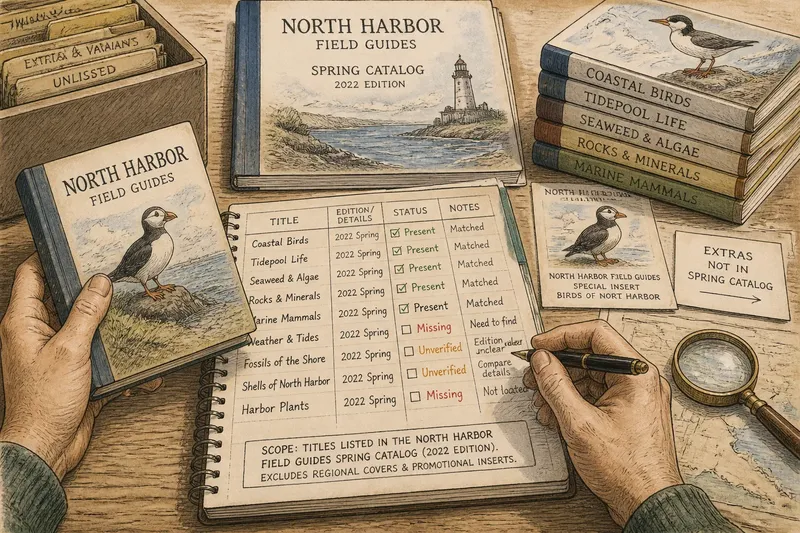
If your goal is to complete a defined release, keep a copy of the checklist or catalog you are following. Record an item’s title or identifier, edition details, and status, and add a note when a listing is unclear. This separates a confirmed gap from an unresolved question.
Do not treat every variation as a separate item unless your chosen source does. A different box, regional label, or promotional insert may matter to one catalog and fall outside another. Your claim should match the inclusion rules, not imply broader coverage than you can document.
Use a checklist that leads to clear decisions
A checklist is useful when each entry has a defined test. Use these checks before marking an item as part of a completed set:
- Check the catalog or checklist name. If you can identify the source and edition, use it as the boundary; if not, label the scope as provisional and avoid claiming full catalog coverage.
- Check the item identifier or title. If it matches a listed entry, mark that entry present; if it does not, keep it in a separate “unlisted” note rather than counting it toward completion.
- Check the edition information. If the listing distinguishes editions and yours matches, count that entry; if the edition is uncertain, mark it unverified and compare the item with a dependable catalog or ask a specialist.
- Check whether a regional release is included. If your scope names that region, include matching releases; if it does not, record them separately instead of silently expanding the set.
- Check the condition requirement. If the entry meets the condition standard you chose, mark it present; if it does not, note the condition and decide whether your set allows imperfect examples.
- Check for promotional or packaging variants. If your source lists them as separate entries, track them individually; if it does not, treat them as notes or extras rather than new required items.
Say you are assembling an invented set based on a fictional “North Harbor Field Guides” catalog. Your written scope says to include only titles listed in its fictional spring edition, not regional covers or promotional inserts. You compare a found guide’s title and edition details with that list, confirm a match, and mark the entry present; a matching promotional insert stays in your extras note because the scope excludes it. The result is a set complete against the stated catalog, not a claim that every related version is included.
Why does the word complete cause confusion?
A list makes progress visible, but an empty entry can start to feel like an obligation. Before seeking an item, check whether it is required by the scope you chose or merely related to the subject.
Collectors may also use “complete” as shorthand without naming their source. Ask which catalog, edition, or release they mean. Their answer may help you refine your own record, but it does not automatically change your collection’s boundary.
How should you describe a collection?
State the source and its limits in plain language: “This set covers the titles in the publisher’s spring catalog,” or “I collect the original editions listed in this series’ index.” If an item’s edition or origin is unresolved, say so rather than presenting it as confirmed.
A spreadsheet can track titles, identifiers, edition notes, and status. A paper notebook works too; the important part is recording which source defines completion and which entries remain uncertain.
What do collectors ask about completeness?
Can a collection be complete if a catalog changes?
It can be complete against a specific version of a catalog, even if a later edition adds entries. Record the catalog version or release you used so the claim stays precise.
Should every packaging variation count?
Count a variation separately only if your stated source or scope treats it as a distinct entry. Otherwise, document it as a variant without turning it into a new requirement.
What if I cannot verify an edition?
Mark the entry as uncertain and avoid counting it as confirmed. Compare identifying details with a dependable catalog or consult a qualified specialist if the distinction matters to your collection.
Can I change my definition of complete?
Yes, but record the new boundary and explain what changed. A revised scope may make earlier claims inaccurate, so update labels and inventory notes to match.
Completeness is a claim about boundaries
A collection can be satisfying without matching anyone else’s idea of “everything.” But when you use the word complete, a named source, clear inclusion rules, and honest notes about uncertainty make the claim understandable.
Keep the scope beside your inventory, especially if a catalog is revised or a disputed edition turns up. That small record lets you revisit the boundary without mistaking an open question for a missing item.